KEY to CAE 2013:

2013 State Convention Test 2013 Fall Forum Tests
2014 State Convention Test IMAGES
2015 State Convention Test KEYS CAE 2013-2017
2016 State Convention Test KEY CAE 2018
2017 State Convention Test KEY CAE 2019
2018 State Convention Test
2019 State Convention Test
2021 State Convention Test
2022 State Convention Test 2023 State Convention Test

Thursday, November 21, 2013

The Deaths of Sarpedon and Memnon

By Lott Gwin       

       
       First, a note on the term “neck amphora.”  The Greek word amphora is a combination of amphi (“on both sides”) and pher-/phor- (meaning “carry”).  Thus, the word refers to a vessel with handles on both sides; it was often used to carry and store wine.  The vase depicted here is called a neck amphora because its handles are placed on the “neck” (thinner upper section) of the jar rather than on the “belly” (thicker, rotund section under the neck). These jars are sometimes decorated with scenes from myth.  The one shown here is late archaic (it dates to about 500 BC) and is painted in the black-figure technique.  It is attributed to the Diosphos Painter, who was active in Athens from ca. 500-475.
       The Trojan war offered Greek vase painters and other artists ample material (for an overview, see S. Woodford, The Trojan War in Ancient Art [1993]).  This vase shows two variations on the theme of the removal of a great warrior’s corpse from the Trojan plain.  In each case the warrior is an important ally of the Trojans.
       On the obverse we see the Thanatos (Death) and Hypnos (Sleep) carrying away the corpse of the Lycian warrior Sarpedon – the subject of another more famous late archaic red-figure vase, the Euphronius crater, which was presented in a previous post (DATE).  Sarpedon, the son of Zeus, was killed in battle by Achilles’ friend Patroclus.  According to Iliad 16, Zeus expressed his grief by crying tears of blood.  The painter has added a number of details.  Blood oozes from the wounds in Sarpedon’s limp body.  As for the deities, they are not the spectacular winged beings of Euphronius’ painting (found HERE).  Instead, they each wear a chiton, corselet, greaves, and a Corinthian helmet; they each carry a spear.  In other words, they are represented as ordinary warriors.  The small winged figure between them is the psyche or soul of Sarpedon flying away.  Readers of the Iliad will recall how the soul is said to float free from the body at the moment of death and flutter off to Hades (cf. e.g. Iliad 22.361-2).

       On the reverse Memnon is being carried off the battlefield by his mother Eos, goddess of the dawn.  Memnon was slain by Achilles (possibly the figure on the left) in single combat.  Achilles fought on behalf of Nestor to avenge the death of Nestor’s son Antilochus at the hands of Memnon.  Nestor would have fought Memnon himself, had he not been too old.  Eos has large wings and is shown aloft.  She wears a chiton, a mantle, and a necklace.  The bird in the upper right-hand corner may stand for the Memnonides, the companions of Memnon who were turned into birds by Eos; it is said that they came every year to lament at his grave.  Eos, for her part, shed tears for him every morning: this is an aetiology for the drops of dew that appear at dawn.

Sources:
Dietrich von Bothmer, “Euphronios and Memnon.  Observations on a Red-Figure          Fragment,” Metropolitan Museum Journal 22 (1987) 5-11.        
Moore, Mary B., and Dietrich von Bothmer, Attic Black-Figured Neck-Amphorae,          Corpus Vasorum Antiquorum, Fascicule 4 (1976) 67-68.

Tuesday, May 21, 2013

Aqueducts

Even though the Romans or the Etruscans did not invent the rounded arch, they used it the most both as a structural element and for design purposes.  Possibly the greatest culmination of the arch is in aqueducts. Aqueducts were huge water transporting structures supported by a series of arcades (arches placed side by side) that could span over 30 miles, as the Pont du Gard does in Nîmes, France.  The engineering that goes into creating such a massive structure is all about weight distribution with each arch buttressing the arches around it.  Although the aqueduct suggests Rome’s power to control the environment to provide for its people, it also suggests an extreme balance and harmony in its engineering.  Frontinus wrote a notable manual on aqueducts.


Thursday, April 11, 2013

A Minoan Treasure


Bull Jumping

   Quite possibly the eldest of all posts to be seen on this blog, this fresco is quite an amazing look into the history of the island city-states around Greece.  A fresco is simply painted plaster, but lasts for an incredibly long time in terrific state.  This breathtaking look into the past was discovered in the ancient city of Knossos, Crete.  It is fascinating that such a fresco, pertaining to an activity with bulls, would be found in Knossos, due to the mythological past of this city.  Crete was once the kingdom of the mythical King Minos, and he reigned in Knossos as his own capital city.  If one remembers, Minos was the son of Zeus and the king of Crete who had restrained the Minotaur.  Born from his wife as half bull and half man the destructive brut was trapped in a labyrinth under his palace, constructed by the genius of the famous architect inventor of mythology, Daedalus   While this doesn't particularly pertain to the piece itself, in order to understand a work, one must understand the culture.  Most cities have a specific animal or god to whom they devote their lives and society.  As Athenians focused on Athena and her wisdom, these people demonstrated a complete and absolute obsession with bulls, depicting them in their architecture, art, culture, and games.
   The fresco itself, probably completed around 1500 BCE, describes a popular sport of the time.  "Bull leaping" involves directly approaching a violent bull.  This appears similar to the spanish practice of bullfighting, however, there are two major differences.  First, this activity involves no harm to the bull, since they are a worshiped animal; no weapons are used and it would be useless to attempt to hurt the bull during the sport.  Second, the challenge, while only possible for the most physically able, is not a feat of pure strength.  An athlete of this sport would have to stand firm as a charging bull would charge directly at the competitor.  The person would then literally grab the bull by the horns, be jolted onto its back, and, if successful, land successfully on its back safely.  Unlike many Roman games, this was not meant to be a blood sport.  Any person who could successfully do this action once would be considered a hero for life.  While this form of bull leaping could have been successful has been debated, but all agree that an activity similar to this was at the center of this culture.  Each people have their own specific and fascinating practice, and this fresco allows for us to look into the practices of an otherwise mythical and mysterious people.

http://hgustafs.myweb.usf.edu/
http://www.mlahanas.de/Greeks/Arts/MinoanBullJump.htm
http://penn.museum/documents/publications/expedition/PDFs/53-3/mcinerney.pdf
http://www.villa-vacanze-creta.it/en/minoan-bull-jumping.aspx

Tuesday, March 12, 2013

The Roman Masterpiece to All Gods


The Classic of Rome; The Pantheon

Like the misfortune that befell the first attempt at the Parthenon, the Pantheon, though constructed in Rome's prime around 17 BCE and free from any threats from invaders, didn't last.  There is a myth that friends of Romulus had constructed the first Parthenon in his honor after his death, building the structure on the site where the king had "ascended to heaven".  However, this is a myth, and very few historians credit this mythology as a viable source. 
  The story of this magnificent temple built for all the gods is still told by the building itself.  While the temple which stands now in Campus Martius is very different in structure, the final sponsor, Hadrian, preserved the legend of the construction, allowing for the inscription on the entrance to read "M-Agrippa-F-Cos-Terum-Fecit".  This is a shortened version of the sentence "Marcus Agrippa Filius Lucii consul tertium fecit", with an implied "id".  This gives credit to the first emperor behind such a magnificent building, saying that "Marcus Agrippa, Servius, son of Lucius, third consul, made (this)".  Agrippa's original temple, while from the name, for all gods, was constructed especially for the gods Mars and Venus, the gods of the Julian family.  While this temple could be called simple in comparison to the structure we see today, Agrippa began the idea of a T-shaped temple, which would be continued on in the following two structures   Quick to be lost, the temple of this cousin of Augustus was burned down in the great fire of 80 CE.  Emperor Domitian then attempted to reconstruct the building soon after, but that temple soon found its end in 110 CE, when it was taken down by lightning.  Finally, the grandiose Emperor Hadrian decided to construct the final version of the Parthenon in 118 CE, still in tact to this day, dedicated to all the gods of Ancient Rome, in the Corinthian style (see glossary).
Red Porphyry Floor of the current Pantheon
   As one can see, the interior of the building is circular.  Filled with the most expensive marbles, even red porphyry, "the quintessential Imperial stone", used in every form of art, including "columns, paving, veneer, basins, sarcophagi, (and) statuary", found only in the Mons Porphyrites in Egypt.  The porphyry was then placed throughout the structure: in statues, along the floors, etc.  Unfortunately for this and many other Roman structures, during the Renaissance, many of these structures with priceless materials were destroyed or smelted down.  The artists would usually put the porphyry into the floors of the most famous Renaissance buildings and the bronze which once covered a great deal of the building was melted down to then cover new structures, put into new works of art.  While we can't see the magnificence of the statues and structures on the walls and buildings, it proved to be to difficult for people of the time to remove materials from the tiled floor, so upon visiting, one can still witness the beauty and intricacy of the tiled marble patterns.
The Oculus
    Hadrian had dreamed to make a temple like no other in Rome; strongly based off of that of the Greeks but incredibly original.  Set into three sections, one would walk through a pronaos, or "an entrance portico" (monolithic.com), then go past a sort of connecting archway, and finally enter the circular, magnificent belly of the beast.  Immediately after entering the temple, one almost feels forced to look up into the famous oculus.  Latin for eye, this is a completely open hole in the center of the concrete ceiling, while now covered by transparent glass for the safety of the marble underneath.  Concrete was moderately modern for the time.  Very convenient and well patterned, this demonstrates the changing of the times, as construction of such magnificent temples become much simpler.  On top of being a beautiful sight, as light will go through and ray down on various parts of the temple throughout the day, this both illuminates the temple and the thought of the gods on a higher dimension than us simple mortals.  Meant to demonstrate both grander and piety, this temple is the cornerstone of classical art history.


Works Cited:
http://penelope.uchicago.edu/Thayer/E/Gazetteer/Places/Europe/Italy/Lazio/Roma/Rome/_Texts/PLATOP*/Pantheon.html 
http://www.aviewoncities.com/rome/pantheon.htm
http://www.monolithic.com/stories/the-pantheon-rome-126-ad
http://www.whyrome.info/rome_pantheon_45.html

Thursday, February 28, 2013

The Lost Treasure of the Parthenon

The Chryselephantine Athena Parthenos


Marble replica

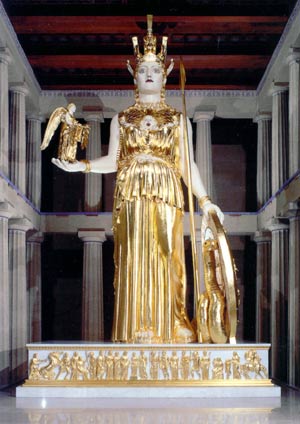
     While the Parthenon had been built to show the splendor of Athens and dedicate their victory over the Persians to Athena, the actual architecture of the structure was particularized around a certain item.  While lost in time and never seen by the modern eye, we know that a certain forty foot sculpture did exist and lied in the center of the temple for centuries, known through the records of various historians of the time.  Furthermore, we are given an idea of how the sculpture may have looked through the multiple copies constructed while the original was still in existence.  This magnificent Athena Parthenos, while lost, is still considered the pinnacle of ancient art.
      However, no replica could ever match the grandeur of the original.  A "chryselephantine"is not a specific piece, but a style.  Like many Greek styles of art, this form of sculpture was carried over from the Egypt.  The style is not measured by strokes, but of material.  A combination of Greek words χρυσος (pronounced "chrysos", meaning gold) and ηλεφαντινος (pronounced elephantinos, meaning ivory), the name describes the object.  While this is the most famous of all chryselephantine works, to the extent that if capitalized, this one of Athena is implied, the only necessary processies for creating such a sculpture would be to create the body of the image out of ivory and put it in a "drapery of gold" (britannica.com).  Unfortunately, there are no longer replicas of such a piece in its original materials, since the two are incredibly expensive and ivory now illegal to produce, being made of elephant tusks.  However, this sculpture was part of the "splurge of the century".  The Persian War had just ended, and the Delian League had fixed it's capital in Athens.  With this shift, Athens became the most influential city state in Greece.  With such victories, no material was considered to expensive or ostentatious when praising their patron goddess, especially since the entire League would be paying, over the lone government.  The sculpture, along with the base, depicting Pandora's birth, are believed to have been completed by the famous sculptor and architect Phidias in 438 BCE, 8 years before his death, during the High Classical Period of art.
        As most art of the ancient time, this colossal sculpture delivered a message.  The majority of the population would be illiterate, so physical representations were often necessary and expected.  The great size and heroic frame of the
goddess of Athens depicted supremacy over the other city states.  In her right hand sits a nike, a goddess of victory, in order to remind the citizens of the great and victorious war that their ancestors had undergone.  Meant to inspire citizens and please the gods who had granted them such a victory, no entity was spared and no symbol undepicted.
Replica denoting appearance
Her breastplate was said to have been adorned with snakes and the head of Medusa, given to her by Perseus through commonly known myth.  In this along with other additions, Phidias demonstrates astounding detail, telling stories without a single syllable.  The theme of victory through just warfare continues on the shield in her left hand.  The outside of this shield depicts the Amazonomachy, or the war where Athenians under the legendary hero Theseus defeated the Amazons.  Inside lies the Gigantomachy, when Zeus ultimately defeated the giants.  In fact, as the evolution of art continues, the giants were no longer seen as human, but terrible, snake-like beasts, increasing the sensation of the man-like gods triumphing over incredible forces.  A third victory is said to have been depicted on the sandals of Athena, which tell of the Centauromachy, against centaurs who had attempted to steal the bride Hippodamia on her wedding day.  Theseus, again an Athenian hero, preformed yet another famous battle against an the formidable and destructive centaurs.  Obviously, these battles mean to idealize the war with the Persians, stating that as powerful as they were, the Greeks were even more so.  The shield of Athena is covering a snake, which while relative to the myth of Ericthronius, also seems to be a promise to the Greeks that Athena would protect them from any danger to come.  Obviously propaganda, this piece is still magnificent.  A tragic loss, its beauty was clearly so great that others had to make replicas, which are atleast a looking glass into this amazing past.

Tuesday, February 19, 2013

Memory of a Revolution

Alexander Sarcophagus

  This magnificent sarcophagus was discovered in the ancient city of Sidon, now in modern day Lebanon.  Beyond the impeccable beauty of the piece, the exquisitely sculpted work tells of a change in the times and turmoil as Alexander the Great began his conquest.  Sidon had originally been a Phoenician port city and pseudo-capital, which had branched out birthed the creation of Carthage and Tyre.  However, during the time of this piece's construction, Alexander the Great had arrived, taken over this ancient city, and promoted a Hellenistic way of life.  While the city was called "persian" since it payed homage and tributes to the shah, Sidon was not directly owned by the shah and basically had its own independence despite offerings.  For this reason, when the Macedonians invaded simply asking for the same, the Sidonians welcomed them with open arms in the fourth century BCE.
     Since this sarcophagus is located in the royal necropolis of Sidon, the structure is believe to house the king of the time, Abdolonymos.  This object clearly shows the significance of the Macedonians in the eyes of the people of Sidon.  Sculpted on each side is the Battle of Issus, the famous battle during 333 BCE where Alexander defeated Darius III.  Clearly adored by the people, Alexander is shown dominating the Persians, adorned in the skin of the Nemean Lion.  Alexander had boasted that he descended from the line of Heracles, and the "defense" of this belief shows impeccable faith in this leader.  Despite the many wars that the two peoples faced against each other, their unity remains as shown through this piece.  Even at death, the king of this region wished to show hommage to such a great and powerful ruler.  Created from the combined Greek, Macedonian, and Phoenician styles, this piece shows the brotherhood which can come out of war.

http://www.booksie.com/non-fiction/article/yavirac/the-alexander-sarcophagus
http://online.wsj.com/article/SB10001424052970204621904574246094055079788.html
http://www.istanbularkeoloji.gov.tr/web/27-106-1-1/muze_-_en/collections/archaeological_museum_artifacts/alexander_sarcophagus

Friday, February 15, 2013

The Gift of Water

The Thermae Diocletiani

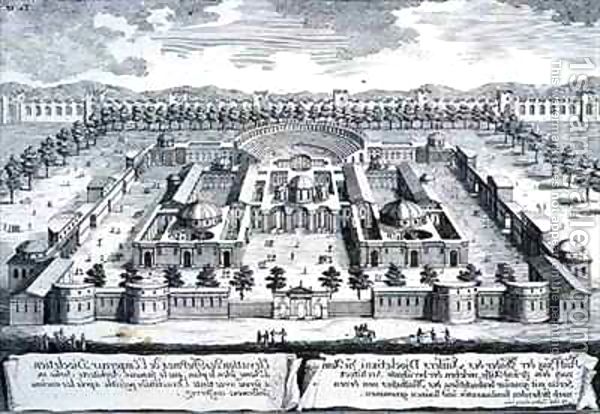
    Known in English as the Baths of Diocletian, this magnificent Early Imperial structure combined the great tradition of the old age and the advanced architecture of this new period.  Like most works of the time, this bathhouse was meant to immortalize the late Emperor Diocletian.  While Emperor Maxentius actually headed the operation that started in 298 CE, it would be left in the honor of the deceased ruler.  Meant to be larger than life, this single bathhouse was able to contain more than three thousand people at a time.  While based off of the Baths of Caracalla and Trajan, the tremendous size and terrific location made this the most memorable of the imperial gifts, finalized in 306 CE.  Built on the Viminal Hill, one of the original seven hills of Rome, water flowed through a series of aqueducts to the spacious rooms.  No expense was spared on this process, as the floors were entirely mosaic and frescoes lined almost every wall.  This structure lasted until the fourth century and the invasion of the Goths.  During their pillage, these people demolished the aqueduct, therefore making water much to scarce to be spared on recreation.  The physical structure underwent a great deal of damage and was eventually built over, so, other than the little saved by Michelangelo in later years, almost none of the original building remains. The portion of the baths that has been conserved has been converted into the Santa Maria deligi Angeli e dei Martiri in Rome.
    This, like the majority of bathhouses, was much more than a space filled with water.  Citizens gathered to this house which not only held baths but libraries, forums for public speaking, gymnasia, and swimming pools.  A social center only matched by the fountain for women, these baths proved to be the center for discussion, socializing, and serious debate.  Obviously hygienic and a positive influence on the welfare of the people, the baths also promoted a healthy city.  The center of this particular house consisted of the caldarium, tepidarium, and frigidarium.  Each in descending order of heat, the caldarium would hold scolding water and was usually used for therapeutic healing or relaxation.  The tepidarium was rather mild in comparison, and were the "warm" baths.  Finally, the frigidarium, by the name, contained frigid water and was also used for healing.  An incredible work, this system of bathhouses, while lost to the ages, will always be remembered as a centerpiece of Roman culture.

http://archeoroma.beniculturali.it/en/museums/national-roman-museum-baths-diocletian
http://www.aviewoncities.com/rome/bathsofdiocletian.htm
http://content.lib.utah.edu/cdm/ref/collection/coa/id/4327
http://penelope.uchicago.edu/Thayer/E/Gazetteer/Places/Europe/Italy/Lazio/Roma/Rome/_Texts/PLATOP*/Thermae_Diocletiani.html
http://www.webphoto.ro/italia/thermae-diocletiani-diocletians-bath-antiquity-museum-of-rome.html

Wednesday, February 13, 2013

The Funerary Vase of a Child

The Eleusis Amphora

   While this vase may appear to be another, simple black figure vase, this piece proves to be extraordinary both in style and in history.  This proves to be a transitional piece, "proto-Attic", as this period during the mid 7th century proved to be the end of the simple Geometric period.  Also known as the Orientalizing period, black figure pottery began to rise in popularity.  With this style came clear depictions of specific characters, never before so unambiguous.  For example, on the neck, highest frieze of this piece, we can clearly see Odysseus blinding the cycloptic son of Poseidon, Polyphemus.  Works like these begin the later common practice of telling common stories with famous characters. through pottery.  While not as visually stunning as a vase like the François, this Attic black figure is a milestone.
   Found in Eleusis, Greece, this amphora was used to hold the ashes of a small child.  Usually for storing wine or oil, this use of the amphora is rather interesting.  Furthermore, the message given by the vase if fascinating.  First we see Odysseus blinding the drunk giant and then convincing him to tell his father that "no one", the name Odysseus gives him self in this act, did this to him; a demonstration of incredible cunning.  Moving downwards, a lion is seen on the shoulder, or frieze under the neck, having sneaked up onto a boar and now preparing an assault.  Furthermore, in the widest portion of the vase, or the body, Perseus is shown fleeing from the Gorgon sisters after discovering how to approach Medusa undetected and kill her without being seen.  While none of these acts were done entirely by fair play, a theme clearly develops.  This cunning means of defeating a formidable enemy occurs often enough that assumptions could be made.  Most vases following this period would be painted to demonstrate a theme or appreciation to a specific god or demigod.  However, this fledgeling vase most likely reflected the theme of cunningness towards the child inside.  The amphora was most likely painted with these specific figures in order to permanently mark this child as a sly and clever boy.

http://www.archaeologychannel.org/video-guide/video-guide-menu/video-guide-summary/106-the-amphora-of-eleusis
http://www.artres.com/C.aspxVP3=ViewBox_VPage&VBID=2UN365YYC5KV&IT=ZoomImageTemplate01_VForm&IID=2F3C2S6W9DQW&PN=2&CT=Search&SF=0
http://www.beazley.ox.ac.uk/tools/pottery/painters/keypieces/protoattic/eleusis.htm
http://employees.oneonta.edu/farberas/ARTH/arth200/politics/greeks_other.html
http://www.metmuseum.org/toah/ht/?period=04&region=eusb
http://www.utexas.edu/courses/introtogreece/lect10/img7erlyprotattic.html

H. W. and Anthony F. Janson, History of Art: the Western Tradition Pearson/Prentice-Hall Upper Saddle River, NJ, 2004

Wednesday, January 30, 2013

The Greek Father in the Acropolis

The Parthenon


   Unfortunately, the first temple built in 480 BCE, the original Parthenon, quickly found its demise at the hands of its enemies.  Within the first eight years after construction had begun, as this limestone-based prototype wasn't even completed, Persians broke into the city of Athens and burned down the entire structure.  Though this temple was dedicated to their namesake goddess, Athena, she was not with these people, as the destroyed ruins were scattered and used as defensive fortifications to separate themselves from such enemies, therefore preventing further loss or more lives, buildings, and valuable pieces of art.
   Soon, however, Athens witnessed its peak as the most prominent polis (term for ancient Greek city-states) in Ancient Greek history.   Having made peace with several of their most dangerous enemies, the Athenians were able to create a Pax Romana-like period of prosperity.  Then secure and able to produce such a structure, the politician Perikles led the new construction of a Parthenon to Athena in 447 BCE.  The Greek city states had recently formed the Delian League, a forced union of Greek city states in self-defense against the Persians.  However the League continued on with a capital in Athens, proving a growth in Athenian influence.  In reality, the Athenians didn't construct the current Parthenon at all.  The Delian
League's treasury was tapped for this construction as a sign of gratitude to the gods.  Perikles continued to overlook the construction, although architects Iktinos and Kalllikrates were the true artists behind the construction.  Built over the location of the Old Parthenon, the structure was made almost entirely of marble from the Pentelic Mountains, even though the foundations were made out of limestone and the doorways wood.  This building was originally made to hold a massive sculpture of Athena, which will be explained in its own post.
   An important note about this temple is that it's columns, and therefore the entirety of the temple, were made in the Doric order.  While very beautiful, this style is often called the most "simple" order.  Void of many extravagant designs, the column is composed of a simple capital (top portion parallell on the picture to the line which mentions the term) and shaft, which is the long, lined portion of the column.  The entrance is lined with eight columns

For anyone to do well on any Art Exam, one must know all three orders well.  While this will be mentioned later in separate posts, we also recommend this site: http://www.cmhpf.org/kids/dictionary/classicalorders.html 

Works Cited:
http://academic.reed.edu/humanities/110tech/parthenon.html
http://www.ancient-greece.org/architecture/parthenon.html
http://www.goddess-athena.org/Museum/Temples/Parthenon/index.htm

Wednesday, January 23, 2013

The Trojan War

The Trojan Horse

   This fresco was created in homage to the greatest war of all of ancient history.  This semi-mythological war involved almost every god and demigod of the age.  While a city that could have been "Troy" has been found, the actual war could not have happened as is said.  In an attempt to finalize the incredibly tedious ten year war, the Greeks decided to facade a surrender.  As a "peace offering", they sent a hallowed horse to the border of the unscalable Trojan fortifications.  As we know, Laocoon, along with the priestess Kassandra, had warned against the Trojan's acceptance of such a gift, but nonetheless the gift was brought into the city, and a great celebration arrose.  Athena is seen in the furthest left statue, with her shield and helmet, watching the scene unfold, over her sanctuary.  She will not defend her people, but allows for insanity to ensue.  In the hollowed horse, a handful of Greek soldiers waited for the perfect moment to strike.  After the Trojans had all returned to their homes, drunk and exhausted, the Greeks would invade the city, destroy the walls, and begin the final scene to the entire war.